
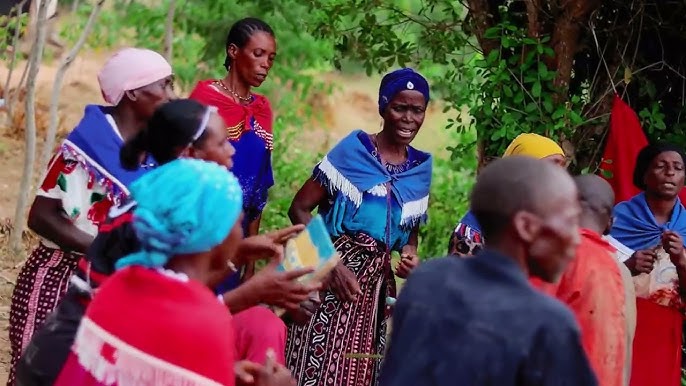
Along the quiet hills and sacred forests of Golini in Kwale County, where the wind moves like a whisper of ancient tales, the Digo people guard a tradition older than memory itself, a healing ceremony known as Kayamba. To outsiders, it is a dance. To the Digo, it is a dialogue between the living and the unseen, a battle for the wellbeing of the afflicted, and a sacred renewal of harmony between humans and spirits.
For generations, the Digo have believed that illness does not always come from the body alone. Sometimes, it arrives on the wings of wandering spirits (mashetani) restless beings who attach themselves to unsuspecting men and women. When this happens, the community calls upon a ceremony that is equal parts poetry, music, and spiritual negotiation.
Kayamba: A ritual born of belief
The Kayamba ritual takes place in the early morning or late evening, moments when the world is soft enough for spirits to listen and humans brave enough to speak. Performed near forests or water bodies, believed to be the natural homes of spirits, the ritual begins with rhythmic rustling from the kayamba, a wooden rattle filled with seeds.
As the rattle shakes, dancers move in a slow, deliberate pattern. Their voices rise in poetic chants, some pleading, some commanding, some praising benevolent spirits known as ruhani. Men play instruments while women lead the dance, their feet drumming the earth as if calling its hidden energies to attention.
Spirit in the Body: Signs of Possession
The Digo have intricate ways of identifying spirit possession. A person said to be possessed may exhibit a sudden fear or anxiety, unexplained fainting or confusion, unusual anger or aggression, sleeplessness or physical weakness and a trance-like states.
These signs, believed to be a cry from the spirit living inside them, guide the Mganga, the traditional healer in diagnosing the nature of the spirit.
Some spirits are gentle; others, stubborn. Some originate from the Arab world (Mwarabu) while others come from neighboring communities like the Duruma. Each spirit responds to different songs, and finding the right chant is like unlocking a hidden door.
The Negotiator: Who is the Mganga?
The Mganga acts as a mediator between worlds. Standing before the crowd, rattles and drums echoing behind him, the healer calls out to the spirit in a voice that vibrates with authority. At first, he is soft-spoken, a negotiator appealing for peace:
“Mwarabu na mkuse, please leave her… allow her freedom.”
But if persuasion fails, his voice hardens:
“Your place is the dry land! Go back to the nyika!”
The possessed person, now in a trance, responds in strange voices or whispers, the voice of the spirit itself. She becomes both messenger and battlefield, her body staging the final confrontation.
Kayamba is never a private ritual. The entire village gathers, surrounding the afflicted person with song and solidarity. Their presence is believed to strengthen her spirit and weaken that of the invader. For many women, who are the most frequent sufferers of possession, the ritual becomes an emotional release, a moment when frustrations of marriage, motherhood, or social pressure find an outlet in culturally acceptable ways.
Through dance, through song, through the collective empathy of her people, the afflicted regains her dignity and peace.
When the spirit leaves
As the drums reach a fevered peak, the spirit finally reveals its demands, perhaps a cloth, a chicken, perfume, or simple recognition. Once the demand is honored, the healer announces the spirit’s departure. The afflicted collapses in relief. Moments later, she rises, calmer, restored. Her first act of recovery is often symbolic: she joins the chorus in song.
The ritual concludes with quiet gratitude. The dancers place their rattles aside. The Mganga wipes sweat from his brow. The villagers disperse, murmuring thanks to the spirits for their willingness to listen.
From generation to generation, the Kayamba continues not just as a healing ritual, but as a cultural performance rich in poetry, rhythm, and symbolism. It reminds the Digo people of the thin veil that separates the seen from the unseen, and of the deep communal ties that hold them together.
It is folklore in motion—sacred, artistic, and deeply human.